
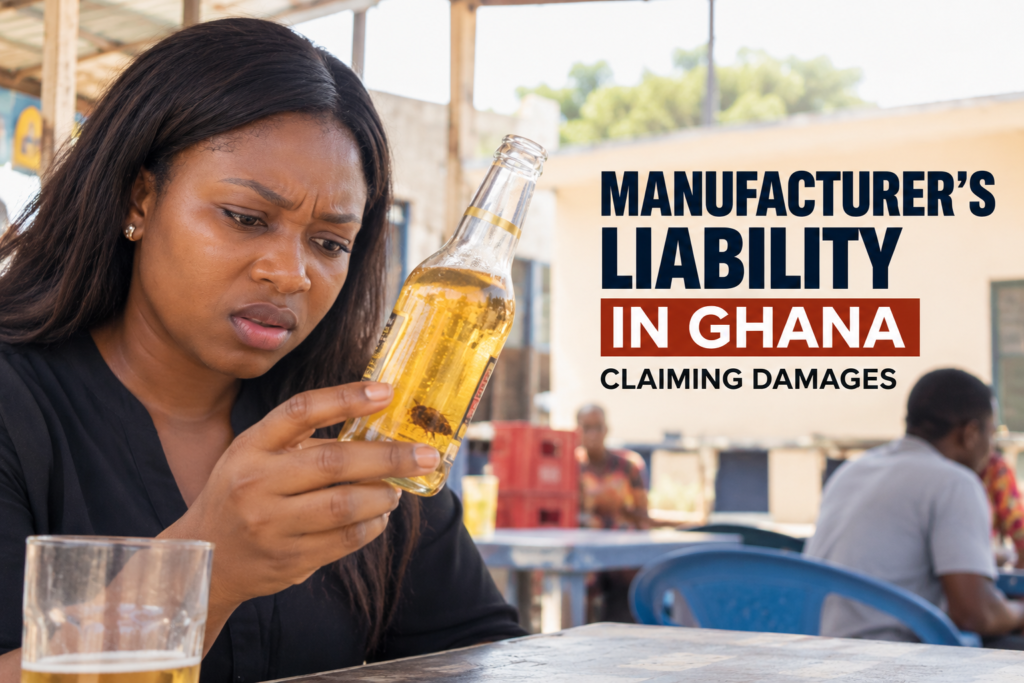
A manufacturer who places a defective or unsafe product on the market may be held legally responsible when that product causes injury or damage. In Ghana, a consumer who suffers harm from contaminated food, a defective electrical appliance, unsafe clothing or another dangerous product may have grounds to pursue a civil claim against the manufacturer or another responsible party.
The law of manufacturer’s liability, also known as product liability, seeks to protect consumers against harm caused by defects in products. The legal principles are particularly important where a product reaches the consumer in the same condition in which it left the manufacturer, without a reasonable opportunity for intermediate examination.
This article explains the meaning of manufacturer’s liability, the applicable law in Ghana, the leading cases, the elements of a claim, possible defences, the remedies available and the practical steps to take when suing a manufacturer.
1. What is manufacturer’s liability?
Manufacturer’s liability refers to the legal responsibility of a manufacturer for injury, loss or damage caused by a defective product where the requirements of an applicable cause of action have been established.
An action for manufacturer’s liability is a civil claim brought by a consumer or another injured person seeking compensation or other appropriate relief for harm caused by a defective or unsafe product.
Liability may arise from negligence in the design, manufacture, inspection, testing or packaging of a product, or from a failure to provide adequate warnings and instructions. Depending on the facts, a claim may also arise under a contract of sale or an applicable statutory obligation.
For example, a consumer purchases an electric kettle that contains a defective electrical component. During ordinary use, the kettle overheats, causes a fire and burns the consumer’s hand. If the evidence establishes that negligent manufacture caused the defect and the resulting injury, the manufacturer may be liable in negligence.
Similarly, if a person discovers a foreign object in a sealed bottle of a drink and suffers injury connected with the contaminated product, the circumstances may support a claim against the manufacturer.
However, the mere fact that a product is defective does not automatically establish every element of a claim for damages. The claimant must establish the applicable legal basis of liability, the relevant breach, causation and legally recoverable harm, subject to any evidential presumptions that may apply.
2. The legal basis of manufacturer’s liability in Ghana
Manufacturer’s liability in Ghana is principally informed by the common law of negligence, the law of sale of goods and applicable legislation governing products and consumer safety.
A. Negligence under the common law
The leading authority is Donoghue v Stevenson [1932] AC 562.
This landmark decision established that a manufacturer may owe a duty of care directly to the ultimate consumer, even where there is no contract between the manufacturer and the consumer. The principle is particularly important where the product is intended to reach the consumer in substantially the same condition as it left the manufacturer, without a reasonable opportunity for intermediate examination.
A manufacturer may therefore be liable in negligence where the manufacturer fails to take reasonable care and that failure causes foreseeable injury to a consumer.
B. Sale of Goods Act, 1962 (Act 137)
The Sale of Goods Act, 1962 (Act 137), provides important protections in contractual claims concerning defective goods.
Section 11 addresses sale by description, while section 12 addresses sale by sample. Section 13 deals with the quality and fitness of goods and provides, among other things, an implied condition concerning defects that have not been declared or known to the buyer, subject to statutory exceptions. It also addresses fitness for a particular purpose in circumstances specified by the Act.
These provisions may be relevant where a consumer or other buyer seeks a remedy against the seller for goods that do not meet the applicable contractual standards.
It is important, however, to distinguish a contractual claim against a seller from a negligence claim against a manufacturer. They have different legal foundations and may involve different requirements. A consumer who purchased a product from a retailer may have a contractual claim against that retailer and, where the evidence supports it, an independent negligence claim against the manufacturer.
C. Product safety and regulatory legislation
Depending on the product, other Ghanaian legislation may be relevant, including the Public Health Act, 2012 (Act 851), in relation to food, drugs and regulated products, and the Ghana Standards Authority Act, 2022 (Act 1078), in relation to standards and conformity matters.
The applicable regulatory requirements depend on the product and the conduct complained of. A breach of a regulatory requirement may be relevant evidence or support a statutory remedy where the law provides for one, but it does not automatically establish every element of a civil damages claim.
A lawyer should verify the current legislation and any product-specific regulations before commencing proceedings. In particular, a general reference to a “Consumer Protection Act, 2025” should not be relied upon without first confirming the enactment and its precise statutory citation.
3. The leading case: Donoghue v Stevenson [1932] AC 562
Facts of the case
In Donoghue v Stevenson, Mrs Donoghue visited a café in Paisley, Scotland, with a friend. Her friend purchased a bottle of ginger beer for her. The drink was contained in an opaque bottle, which made it difficult to inspect its contents.
After Mrs Donoghue had consumed some of the drink, the remaining contents were poured out and the decomposed remains of a snail allegedly emerged from the bottle. She claimed that she suffered shock and severe gastroenteritis as a result.
Mrs Donoghue had not purchased the ginger beer herself, and therefore could not rely on a contract of sale between herself and the retailer. She consequently brought an action in negligence against the manufacturer, David Stevenson.
The principal legal question was whether the manufacturer owed a duty of care to the ultimate consumer despite the absence of a contractual relationship between them.
Decision and legal principle
The House of Lords, by a majority, recognised that a manufacturer could owe a duty of care directly to the ultimate consumer. Lord Atkin articulated the neighbour principle, according to which a person must take reasonable care to avoid acts or omissions that can reasonably be foreseen as likely to injure persons closely and directly affected by their conduct.
The principle is commonly expressed in the context of manufacturer’s liability as follows: a manufacturer who intends a product to reach the ultimate consumer in substantially the same condition in which it left the manufacturer, without a reasonable possibility of intermediate examination, owes a duty to take reasonable care where a failure to do so may foreseeably cause injury.
Importance of the case in Ghana
The case is important to Ghanaian tort law because it provides a foundational common-law principle for claims involving defective products.
It establishes that the absence of a direct contract between a manufacturer and an injured consumer does not, by itself, prevent the consumer from suing the manufacturer in negligence.
For example, a person who purchases a sealed bottle of a drink from a retailer may potentially sue the manufacturer if a manufacturing defect causes personal injury. The claimant must still establish the applicable elements of negligence, subject to any relevant evidential presumptions.
4. Can a manufacturer be liable for products applied externally?
Yes. Manufacturer’s liability is not restricted to food, drinks, medicines or products taken internally. It may also extend to clothing, cosmetics, electrical appliances and other products used externally.
The leading authority is Grant v Australian Knitting Mills Ltd [1936] AC 85.
Facts of Grant v Australian Knitting Mills
Dr Grant purchased woollen underwear from a retailer. After wearing the garments, he developed dermatitis. Investigation established that excess sulphites, a chemical used in the manufacturing process, had been negligently left in the garments.
The chemical irritant was a latent defect that could not reasonably have been discovered through ordinary examination of the garments.
Dr Grant sued the manufacturer and the retailer. The Privy Council held that the manufacturer was liable in tort for negligence, while the retailer was liable under the applicable sale-of-goods provisions.
Legal principle
The case demonstrates that the manufacturer’s duty of care extends to products that come into contact with the body. There is no general distinction between a harmful substance that is consumed internally and one that causes injury through external contact.
The case also illustrates the importance of latent defects. A product may appear normal but contain a hidden defect that makes it unsafe for its intended use.
In Ghana, this principle may be relevant to claims involving contaminated clothing, harmful cosmetics, defective skin-care products and other items that cause injury when used as intended.
5. Manufacturer’s liability in Ghana: Aboagye v Kumasi Brewery Ltd [1964] GLR 242
One of the most important Ghanaian authorities on manufacturer’s liability is Aboagye v Kumasi Brewery Ltd [1964] GLR 242–247.
Facts of the case
The plaintiff, Aboagye, was drinking Star beer with friends when he discovered a rotten palm nut inside the bottle. He subsequently experienced vomiting and frequent stools. He sought medical attention and brought an action against Kumasi Brewery Ltd, alleging that the brewery had negligently manufactured or bottled the beer.
The brewery denied negligence and relied on its manufacturing processes and quality-control procedures, which it argued were designed to prevent contamination.
Issue before the court
The central questions included whether the foreign object was present in the bottle, whether its presence established negligence on the part of the manufacturer and whether the plaintiff’s illness was connected with the incident.
Decision
The High Court accepted the evidence that the palm nut was present in the beer bottle. It held that the circumstances raised the application of the maxim res ipsa loquitur, thereby establishing a prima facie case of negligence against the manufacturer.
The court was not satisfied that the brewery had rebutted that case merely by relying on its manufacturing procedures. The presence of the foreign object in the bottled product supported the inference that reasonable care had not been exercised.
Legal principle: Res ipsa loquitur
The Latin maxim res ipsa loquitur means “the thing speaks for itself.”
In negligence cases, the doctrine may permit the court to infer negligence from the nature of an occurrence where the circumstances are such that the event would not ordinarily happen if proper care had been taken, and the relevant cause was within the defendant’s management or control, subject to the applicable evidential requirements.
In a product contamination case, the presence of a foreign object inside a sealed bottle may support an inference of negligence where the evidence indicates that the product remained under the manufacturer’s effective control until it reached the consumer.
The doctrine does not automatically establish every element of liability, nor does it create irrebuttable liability. It establishes a prima facie case that the defendant may seek to rebut with sufficient evidence.
Significance of the decision
Aboagye v Kumasi Brewery Ltd is particularly relevant to Ghanaian consumers because it demonstrates that a manufacturer may be held liable where contamination of a sealed product supports an inference of negligent manufacture.
It also demonstrates that a manufacturer cannot necessarily defeat a claim simply by showing that it operates modern machinery or maintains quality-control systems. The court must consider whether those systems adequately explain the defect and whether the defendant has rebutted the inference arising from the evidence.
6. Another Ghanaian authority: Acheampong v Overseas Breweries Ltd
Another relevant Ghanaian decision is Acheampong v Overseas Breweries Ltd (High Court, Kumasi, 15 July 1970).
The plaintiff, a barrister, alleged that he suffered personal injury after consuming beer manufactured by the defendant and discovering that it contained kerosene. He sued for damages, alleging negligence and failure to take adequate precautions during manufacture.
The case considered authorities including Donoghue v Stevenson, Grant v Australian Knitting Mills Ltd and Aboagye v Kumasi Brewery Ltd. It is therefore useful when discussing the application of manufacturer’s liability principles to contaminated beverages in Ghana.
The case reinforces the importance of examining the manufacturing process, the presence of harmful substances in a product, the evidence connecting the contamination to the manufacturer and the causal relationship between the product and the injury.
These Ghanaian cases illustrate that claims involving contaminated beverages are not merely theoretical. The courts have considered whether a manufacturer exercised reasonable care and whether the circumstances of contamination justify an inference of negligence.
7. The essential elements of a claim for manufacturer’s liability
A person who wishes to sue a manufacturer in Ghana must establish the elements of the particular cause of action relied upon. In a negligence claim, the following matters are especially important.
1. The defendant is the manufacturer or another responsible party
The claimant must identify the manufacturer or establish the legal responsibility of the defendant being sued.
Relevant information may include the product label, manufacturer’s name, packaging, serial number, batch number, import documentation and purchase records.
Depending on the facts, responsibility may also arise on the part of an importer, distributor, retailer or another person involved in supplying the product. Each defendant’s liability must be established on the applicable legal basis.
2. The product contained a defect or was otherwise unsafe
The claimant must identify the defect or other actionable failure. Common examples include:
* Manufacturing defects: The particular product deviated from the intended specifications during production.
* Design defects: The product’s design created an unreasonable and foreseeable risk of harm under the applicable legal test.
* Failure to warn: The manufacturer failed to provide adequate warnings about a foreseeable danger.
* Inadequate instructions: The manufacturer failed to provide necessary instructions for the product’s safe use.
* Contamination: A foreign object, harmful chemical or other dangerous substance entered the product during production, packaging or handling.
Not every product malfunction proves negligence. The evidence must establish the defect and connect it to the relevant legal obligation.
3. The manufacturer owed a duty of care
In a negligence claim, the claimant must establish that the manufacturer owed a duty of care to the injured person.
Under Donoghue v Stevenson [1932] AC 562, such a duty may arise where the manufacturer could reasonably foresee that a failure to take care in preparing or manufacturing the product would cause injury to the ultimate consumer.
The duty may apply even though the consumer purchased the product through a retailer and has no direct contract with the manufacturer.
4. The manufacturer breached the duty
The claimant must establish that the manufacturer failed to exercise the reasonable care required in the circumstances.
The alleged breach may involve inadequate inspection, negligent manufacturing, insufficient testing, contamination, defective packaging or a failure to give appropriate warnings.
Evidence of a defect may, in suitable circumstances, support an inference of negligence under res ipsa loquitur, as illustrated by Aboagye v Kumasi Brewery Ltd [1964] GLR 242.
5. The defect or breach caused the injury
The claimant must establish a legally sufficient causal connection between the defendant’s breach and the harm suffered.
For example, where a consumer alleges that a defective electrical appliance caused a fire, the evidence should connect the defect to the fire rather than to an unrelated electrical fault or an independent event.
Medical evidence, expert reports, photographs and witness testimony may be necessary to establish causation.
6. The claimant suffered legally recoverable damage
A negligence claim generally requires proof of actual harm. Depending on the circumstances, this may include bodily injury, property damage and other financial losses recognised by law.
A consumer who discovers a defect but suffers no injury or other legally recoverable loss may still have contractual or statutory remedies, but a claim for negligence damages cannot simply assume that the discovery of a defect establishes compensable injury.
7. The loss is not too remote
The claimant must also satisfy the applicable rules on remoteness of damage. The type of harm must be sufficiently connected to the breach under the relevant legal principles.
For example, a manufacturer may be responsible for foreseeable burns caused by an overheating appliance, but the legal treatment of a subsequent, unrelated loss would require separate analysis.
8. Defences available to a manufacturer
A manufacturer sued for product-related injury may raise a number of defences. Their availability and effect depend on the cause of action and the evidence.
A. The product was not defective
The manufacturer may argue that the product was properly manufactured, safe for its intended use and compliant with the applicable requirements.
Compliance with a standard may be relevant evidence, but it does not necessarily prove that the manufacturer exercised reasonable care in every respect.
B. Absence of negligence
The manufacturer may demonstrate that reasonable care was exercised in the design, manufacture, inspection, testing and packaging of the product.
In Aboagye v Kumasi Brewery Ltd [1964] GLR 242, however, the court did not regard the existence of an apparently effective manufacturing system as sufficient, by itself, to rebut the prima facie case arising from the presence of a foreign object in the bottled beer.
The question is whether the evidence adequately explains the occurrence and establishes that the defendant was not negligent.
C. No causal connection
The defendant may argue that the alleged defect did not cause the injury or loss.
For instance, a consumer may allege that an appliance caused an electrical injury, while expert evidence may indicate that the injury resulted from a separate wiring defect in the premises. The court must evaluate the evidence to determine causation.
D. Misuse of the product
The manufacturer may argue that the claimant used the product in a manner that was neither intended nor reasonably foreseeable.
The significance of misuse depends on the circumstances. A manufacturer is not necessarily relieved of responsibility merely because the consumer used the product in a way that differs slightly from the instructions, particularly if the use was reasonably foreseeable.
E. Subsequent alteration or interference
The defendant may argue that the product was altered, repaired or tampered with after it left the manufacturer’s control, and that the alteration caused the defect or injury.
This defence may be relevant where the evidence establishes that a third party modified an appliance or interfered with a product after manufacture.
It must be distinguished from the mere allegation that interference was possible. The defendant must establish the relevance of the alleged alteration to the actual defect and injury.
F. Failure to follow safety instructions
A manufacturer may argue that the claimant ignored clear and adequate safety instructions and that this contributed to the harm.
The legal effect depends on whether the instructions were sufficient, whether the risk was adequately explained and whether the claimant’s conduct caused or contributed to the injury.
G. Contributory negligence
Where the claimant’s own lack of reasonable care contributed to the injury, contributory negligence may affect the damages recoverable, subject to the applicable law.
It does not automatically follow that the manufacturer escapes all liability. The court must consider the claimant’s conduct and the applicable legal principles.
H. Limitation of actions
A manufacturer may contend that the claim was commenced outside the applicable limitation period.
The relevant period depends on the nature of the action and the applicable legislation. A claimant should therefore seek legal advice promptly rather than assume that a claim can be brought at any time.
I. Absence of contractual relationship
Where the claimant relies exclusively on a contractual cause of action, the defendant may dispute whether the claimant has the necessary contractual relationship to enforce the alleged obligation.
However, Donoghue v Stevenson [1932] AC 562 establishes that the absence of a direct contract does not, by itself, defeat an independent negligence claim against a manufacturer.
J. Latent defects and the absence of reasonable inspection
A latent defect is a hidden defect that could not reasonably have been discovered through an appropriate examination.
In Grant v Australian Knitting Mills Ltd [1936] AC 85, the chemical irritant in the clothing was a hidden defect. The decision illustrates why a manufacturer cannot necessarily avoid liability merely because the defect was not apparent on ordinary examination.
Latency is therefore not a universal defence for a manufacturer. Depending on the cause of action, a hidden defect may instead support the claimant’s case.
9. How to sue a manufacturer in Ghana
A claimant considering an action against a manufacturer should take practical steps to preserve evidence, identify the appropriate cause of action and establish the amount of the loss.
Step 1: Consult a lawyer
The claimant should explain what happened, identify the product and describe the injury or damage suffered.
The lawyer will assess the available facts, identify potential defendants and consider whether the claim should be based on negligence, contract, applicable statutory obligations or a combination of legally supportable causes of action.
Step 2: Preserve the defective product
The product should be retained where it is safe and lawful to do so. The claimant should also preserve packaging, labels, receipts, warranties, serial numbers and batch information.
The product should not be discarded, repaired or dismantled before appropriate evidence has been preserved and, where necessary, an expert has inspected it.
Where the product presents a continuing danger, safety should take priority. It should not be used merely to preserve evidence.
Step 3: Gather documentary evidence
The claimant should collect photographs and videos of the defect, purchase receipts, correspondence with the seller or manufacturer, product instructions, advertisements and any relevant recall notices.
Witnesses who saw the incident or the condition of the product may also provide useful evidence.
Step 4: Obtain expert evidence
Where the defect is technical, the lawyer may arrange for a suitably qualified expert to examine the product.
An expert may be able to explain how the defect arose, whether it was present when the product left the manufacturer, whether reasonable precautions should have prevented it and whether the defect caused the alleged harm.
Step 5: Obtain medical or property-damage evidence
For personal injury, the claimant should obtain relevant medical reports, treatment records, prescriptions and receipts.
Where property has been damaged, repair estimates, valuations, photographs and evidence of replacement costs may be relevant.
These records help establish both causation and the amount of compensation sought.
Step 6: Identify the appropriate legal basis
The lawyer should determine whether the claimant has a viable negligence claim, a contractual claim against the seller, a statutory claim or another recognised cause of action.
The distinction is important because different causes of action have different elements, available remedies and potential defendants.
Step 7: Send a letter of demand
Where appropriate, the lawyer may send a formal letter of demand to the manufacturer or another responsible party.
The letter should identify the product, explain the incident, outline the alleged defect and legal basis of the claim, identify the injury or loss and state the remedy sought.
Depending on the circumstances, the claimant may request compensation, a refund, repair, replacement or another appropriate remedy.
Step 8: Consider a regulatory complaint
Depending on the product, the lawyer may consider a complaint to the relevant regulatory authority. The Food and Drugs Authority may be relevant to regulated food, drugs and other products within its mandate, while the Ghana Standards Authority may be relevant to applicable product standards and conformity matters.
A regulatory complaint may assist with investigation or product-safety concerns, but it does not necessarily replace a civil action for compensation.
Step 9: Commence proceedings where necessary
If the dispute cannot be resolved, the lawyer may prepare and file the appropriate court documents in a court with jurisdiction.
The claim should identify the parties, set out the material facts, explain the alleged defect and breach, establish the connection between the breach and the injury or loss, and specify the remedies sought.
The lawyer must comply with the applicable procedural rules, limitation requirements, filing requirements and service obligations.
Step 10: Prepare for trial
The claimant may need to provide witness testimony, documentary evidence, expert reports and other relevant material.
The defendant may challenge the alleged defect, the evidence of negligence, the causal connection and the amount of the damages claimed.
Step 11: Judgment and enforcement
If the claim succeeds, the court may award damages or grant another remedy available under the applicable law.
The claimant may then need to take steps to enforce the judgment. An appeal may be available where there are proper legal grounds.
10. Remedies for manufacturer’s liability in Ghana
The remedies available depend on the cause of action, the nature of the injury and the evidence presented.
Damages for personal injury: A claimant may recover compensation for bodily injury caused by the manufacturer’s actionable breach. The award may take account of pain, suffering and loss of amenity, where applicable.
Medical expenses: Reasonable medical expenses attributable to the injury may be recoverable where properly established.
Property damage: A claimant may seek compensation for property damaged by the defective product, including repair or replacement costs where legally recoverable.
Loss of earnings: A claimant may recover proven earnings lost because of the injury. Future loss of earnings may also be recoverable where the evidence and applicable legal principles support the claim.
Other financial losses: Other losses may be recoverable if they are legally recognised, sufficiently connected to the defendant’s breach and adequately proved.
Contractual remedies: Where the claim arises under the Sale of Goods Act, 1962 (Act 137), or the relevant contract, the buyer may be entitled to remedies such as rejection, damages or other relief, depending on the circumstances and applicable requirements.
Interest and costs: The court may award interest and costs in accordance with the applicable law and procedural rules.
A claimant should not assume that every remedy is available against every defendant. For instance, a contractual remedy against a retailer may differ from damages in negligence against a manufacturer.
11. Frequently asked questions
Can I sue a manufacturer in Ghana if I bought the product from a retailer?
Yes, potentially. Under Donoghue v Stevenson [1932] AC 562, a manufacturer may owe a duty of care directly to the ultimate consumer even where there is no contract between them.
You must still establish the requirements of the applicable claim, including the relevant breach, causation and legally recoverable damage.
Can I sue a manufacturer if I did not personally buy the product?
Potentially, yes. A person injured by a defective product is not necessarily barred from bringing a negligence claim merely because someone else purchased it. The relevant question is whether the manufacturer owed that person a duty of care and whether the other requirements of the claim are satisfied.
What if I find a foreign object in a sealed bottle?
Preserve the bottle and its contents safely, take photographs and record the batch information. Avoid consuming any more of the product.
Aboagye v Kumasi Brewery Ltd [1964] GLR 242 is a relevant Ghanaian authority. The court held that the presence of a rotten palm nut in a bottle of beer supported an inference of negligence under res ipsa loquitur. Whether a similar inference arises in another case depends on its facts and evidence.
Must I prove that the manufacturer was negligent?
For a claim based on negligence, the claimant must establish the applicable elements of negligence. However, in appropriate circumstances, res ipsa loquitur may permit the court to infer negligence from the circumstances of the incident.
Other causes of action, including contractual and statutory claims, may have different requirements.
Can I sue for a defective product if I suffered no physical injury?
Possibly. A contractual or statutory remedy may be available even where there is no personal injury, depending on the applicable law and the nature of the loss. However, a negligence claim for damages ordinarily requires proof of legally recoverable harm.
How long do I have to sue?
The applicable limitation period depends on the nature of the claim and the relevant legislation. Personal injury, contractual and other claims may be subject to different rules. A lawyer should confirm the applicable period promptly, particularly where the defect was discovered some time after purchase.
Conclusion
Manufacturer’s liability is an important aspect of consumer protection and tort law in Ghana. It holds manufacturers accountable where their actionable failures cause injury or damage to consumers.
The leading authorities establish the foundation of this area of law. Donoghue v Stevenson [1932] AC 562 recognises a manufacturer’s duty of care to the ultimate consumer; Grant v Australian Knitting Mills Ltd [1936] AC 85 demonstrates that the duty extends to products applied externally; and Aboagye v Kumasi Brewery Ltd [1964] GLR 242 illustrates how the presence of a foreign object in a sealed beverage may support an inference of negligence under res ipsa loquitur. Acheampong v Overseas Breweries Ltd (1970) is another relevant Ghanaian authority concerning alleged contamination of beer.
A consumer who suffers injury from a defective product should preserve the product, obtain appropriate medical or expert evidence, identify the responsible parties and seek legal advice on the available remedies.
Ultimately, a manufacturer is not automatically liable merely because a product is defective, but where the applicable legal requirements are established, the law may provide a remedy against the manufacturer or another responsible party.
Legal note: This article is for general legal education and is not a substitute for advice on the facts of a particular case. The relevant legislation, limitation periods and available remedies should be verified before proceedings are commenced.